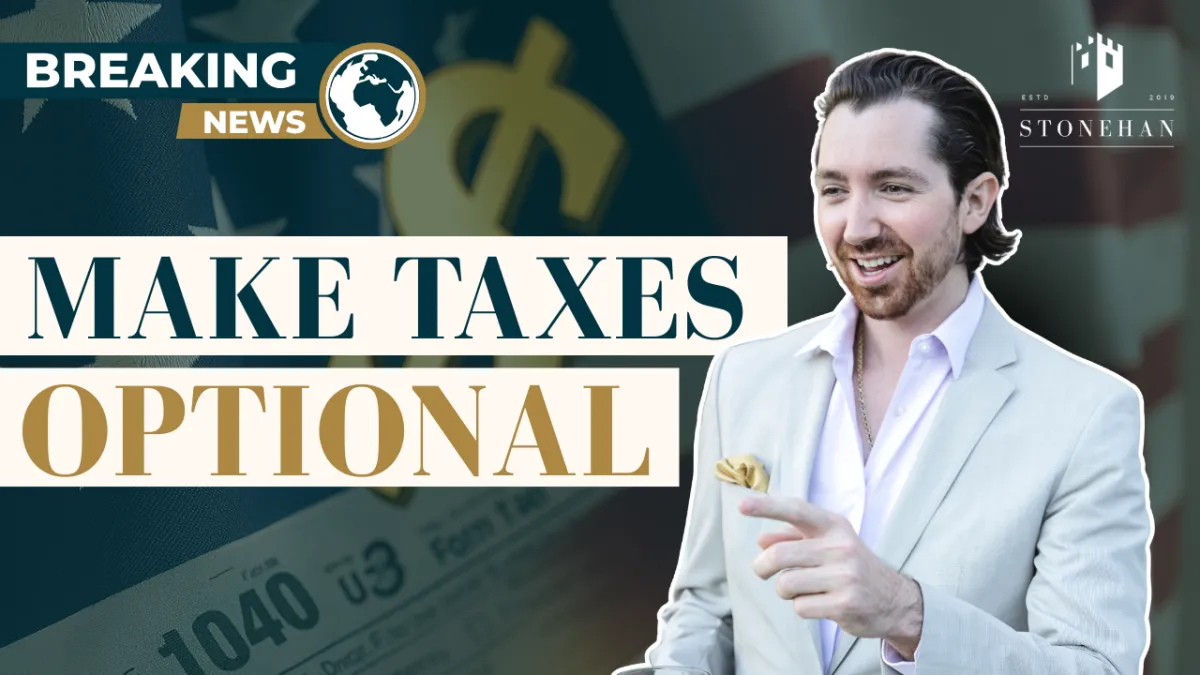
How Fund Managers Legally Reduce Taxes | Christian Capitalist Interview
Featuring: Russell Gray (Christian Capitalist Podcast) & James Bohan, CPA, MRED
This conversation originally aired on the Christian Capitalist Podcast, where host Russell Gray invited CPA and fund CFO James Bohan to unpack how sophisticated investors legally make taxes “optional” while staying fully aligned with Christian values, stewardship principles, and Main Street economics.
James explains why the tax code rewards people who build housing, fund businesses, support communities, and take economic responsibility, and how fund managers, GPs, and real estate operators can structure their affairs accordingly.
Summary:
Most high earners overpay in taxes because they operate inside the retail tax system, W-2 income, limited deductions, and minimal use of incentives. But sophisticated investors and fund managers operate differently.
In this episode, James breaks down:
Why the tax code is a policy tool, not a moral test
How values-based capital allocators reconcile “Render unto Caesar” with proactive tax planning
The differences between W-2, business owners, and fund managers from a tax standpoint
Why entity structuring is foundational for tax efficiency
How real estate creates phantom deductions, accelerated write-offs, and tax-free liquidity
How income becomes equity, and how real estate generates infinite returns
Why day trading is almost always the least tax-efficient way to build wealth
The heart of the message: If you want to change what you fund, you must change how you earn, own, and structure your capital.
Watch the Full Episode:
FAQ's
1. How do fund managers legally reduce their taxes?
Fund managers use entity design, real estate incentives, depreciation, carried interest rules, and income-shifting strategies. These are policy-driven incentives created specifically for capital allocators.
2. Is it ethical for Christian investors to minimize taxes?
Yes. As James explains, the tax code is a policy tool meant to reward productive behavior, such as building housing, creating jobs, and supporting communities. Stewardship includes using the incentives available.
3. Why does real estate offer more tax benefits than stocks?
Real estate provides phantom depreciation, accelerated write-offs, tax-free refinances, and 1031 exchanges. Stock trading, in contrast, produces ordinary income and short-term gains with minimal tax sheltering.
4. What entities should fund managers consider?
Fund managers commonly use partnerships for LP/GP structures, S-Corps for active operator income, and C-Corps for QSBS, income shifting, and medical reimbursements. The right design depends on their strategy.
5. How does income shifting work for family offices?
Income can be moved from a high-bracket taxpayer to a low-bracket family member (such as a child) who legitimately performs work for the business. This reduces overall tax liability within the economic unit.
📞 Book a Tax Strategy Call with James:
https://calendly.com/jamesbohan/book-a-call
📨 Connect With James:
LinkedIn: James Bohan, CPA, MRED
Instagram: @jamesbohancfo
Website: stonehan.com
Chapter Breakdown With Timestamps:
00:00 — Intro: Why high earners and fund managers are overpaying
02:10 — James’ background: CPA → Wall Street → real estate funds → CFO → Stonehan
06:45 — The system we live in: Federal Reserve, IRS, and policy over politics
10:30 — Faith & taxes: What “Render unto Caesar” truly means
14:02 — The ethics of using deductions, incentives & “loopholes”
18:20 — Why governments incentivize certain behavior through the tax code
21:05 — W-2 limitations & how to begin transitioning out
23:40 — Entity basics: LLCs, S-Corps, C-Corps, Schedule C
28:15 — Advanced C-Corp strategies: QSBS, income shifting, medical reimbursements
32:48 — Small business tax strategy: accelerating expenses, credits, planning windows
37:10 — Income shifting & family-office style planning
Real Estate & Fund Strategy
41:35 — Why real estate is the most tax-advantaged asset class
43:00 — Depreciation 101: The phantom expense
45:05 — Cost segregation & bonus depreciation
48:12 — 1031 exchanges & tax-free equity movement
50:20 — Cash-out refinancing & infinite returns
54:40 — How cash flow → equity (and why “fake equity” collapses)
58:05 — Stocks vs. real estate: tax inefficiency of churn
Values, Stewardship & Optional Taxation
1:01:30 — Funding what aligns with your values
1:04:00 — Using incentives to build communities, not bureaucracy
1:06:10 — Key takeaways for fund managers, PE, and family offices
1:07:00 — How to work with James
Original Episode:
This conversation originally aired on the Christian Capitalist Podcast.
Listen or watch here: https://www.pray.com/russellgray/videos
Full Transcript:
00:00 Intro: Why high earners and fund managers are overpaying
Russell (00:00):
Before we get started, I want to cover some background. I want to talk about the struggles many Christians have when it comes to paying taxes. You know, “Render unto Caesar what is Caesar's” is probably the most famous scripture in this conversation.
But there is also the issue of ethics in paying taxes that fund things like abortions, wars, and other actions you may morally disagree with. Then there is the civic duty of paying for the parts of government that you do support.
And finally, stewardship. As an asset manager or as a virtual CFO, you have an obligation to maximize the bottom line for shareholders. I even have friends who believe it is unethical to take deductions. They call them loopholes. I want to address that, too.
We will also talk about cash flow and equity. My philosophy is simple: cash flow is equity. When you have more cash flow, you have more equity. We may or may not get deep into that today, but it is an important concept.
Most importantly, I want to lead people toward understanding real tax mitigation strategies. We will talk about the different tax categories active, passive, portfolio income, long term and short term capital gains, and how each one impacts your tax liability.
Of course, real estate has the 1031 exchange, which is one of the most important tools, but that is not the only strategy I want to hit. I also want to tease some advanced concepts like endowments and using equity to create deductions.
Does that all make sense from what we discussed last time?
02:10: James’ Background: Wall Street funds to real estate funds to CFO to Stonehan
James (02:10):
Yes, that all makes sense. Last time we spoke, we talked about the strategy where you take a tax free refinance and use those proceeds to make a tax deductible charitable contribution. That is one of the ideas you are referring to.
Russell (02:42):
Exactly. And I also want to touch on tax mitigation for employees, business owners, and fund managers. Ultimately, I want to point people toward your newsletter, because many listeners will want deeper guidance.
Let’s start by having you introduce yourself. You are a Christian CPA, a Main Street capitalist, and now a fund CFO. Can you give people some background?
James (03:05):
Sure. I started my career as a CPA working with Wall Street funds. I came from a real estate family, so naturally I ended up working in the real estate fund division of a firm that specialized in hedge funds and private equity funds.
This was around 2009 to 2010, before the JOBS Act. So I learned how billion dollar funds acquired real estate and structured investment vehicles.
I did that for about five years before the firm was acquired by KPMG. Around that time, I went back to USC and earned my master’s in real estate development, graduating in the top five percent of my class. One of my professors hired me to help start a real estate lending debt fund.
I was the first employee. Over several years we brought on 1,400 LPs and originated over a billion dollars in loans. I became CFO.
Eventually, I realized that although I felt like an entrepreneur, I did not have entrepreneurial upside. My boss was honest with me and said they would not be able to compensate me at the level I expected. So I left in 2019 and started my own CPA firm while also investing in real estate.
When COVID hit, I was already working remotely, so I moved from Los Angeles to Idaho. Since then, I have helped start a few small businesses, launched a farmer’s market, and invested in redevelopment projects around North Idaho. Alongside that, I continue to grow my CPA practice, helping fund managers, entrepreneurs, and syndicators navigate complex tax strategy and fund administration.
06:45: The system we live in: Federal Reserve, income tax, and policy over politics
Russell (06:45):
We met at the Best Ever Conference. You were sitting across the table while I was talking, as usual, and afterward you said we probably had a lot in common. That led to us becoming friends.
One of the things that shaped my thinking was homeschooling my kids. While teaching civics and economics, I realized how much public education leaves out.
When I studied the Federal Reserve system, the income tax code, and the 16th Amendment, I concluded that the system is designed to put people into debt. The scripture “the borrower is servant to the lender” became very real to me. The income tax is what services government debt.
Whether we like the system or not, this is the system we operate within. So the question becomes: how do we navigate it as Christians who want to steward our resources responsibly?
Let’s get into the faith side of taxes. What are your thoughts about “Render unto Caesar” and how Christian investors should interpret that?
10:30: Faith and taxes: What “Render unto Caesar” really means
James (10:30):
I always start with the scripture itself: “Give to Caesar what is Caesar’s, and give to God what is God’s.”
The coin had Caesar’s image on it, so it belonged to Caesar. We are made in God’s image, so we belong to God.
But I like to ask: what exactly is due to Caesar? Because the tax code is full of rules. There is one law that says you must pay taxes, but thousands of laws that say you may reduce those taxes if you follow certain incentives or structure things correctly.
So my job is to understand what Caesar has put into the tax code and argue, legally, about what truly is due.
Russell (11:28):
Some Christians feel that taking deductions is immoral, that it is gaming the system. What do you say to them?
James (11:40):
Most people who say that on my posts are LinkedIn trolls.
I believe the opposite. It is your moral responsibility to pay as little in taxes as legally possible. There is even a Supreme Court ruling that says so.
The federal government often uses tax revenue for things that many Christians find immoral. War. Abortion. Waste. These things go against my Christian values and my free market values.
Money represents your time and energy. Your life force. I do not want my life force funding evil. I have no problem paying reasonable taxes in Idaho because I see the value delivered. But federally, it is a different story.
14:02: Ethics of deductions and “loopholes”
Russell (14:02):
Now that we have talked about the spiritual and ethical side, I want to explore something practical. There are Christians who believe that using deductions is morally wrong, that it is somehow dishonest to reduce their tax liability. You touched on this, but can you expand on why you believe it is not only acceptable but responsible to use the incentives in the tax code?
James (14:26):
Sure. Taxes are the largest expense most people will ever pay in their lifetime. When the government uses that money for things you believe are immoral or destructive, it is worth questioning why you should give them any more than legally required.
The tax code is a set of incentives. It is designed to reward certain behaviors. If you are building housing, creating businesses, employing people, or adding value to the economy, the government incentivizes that. If you simply earn a W-2 income, you are taxed the highest because you are not doing the things the government wants to reward.
To me, it is not immoral to reduce tax liability through legal strategies. It would be immoral not to.
Russell (15:15):
That is a powerful statement. And you are right. The incentives are there for a reason. They are not loopholes. They are instructions.
18:20: Why governments incentivize behavior through the tax code
Russell (18:20):
Let us talk about why the tax code is structured this way. People often assume taxes are simply imposed, but in reality the tax code is full of incentives that push people toward certain economic activities. Why is that?
James (18:40):
The tax code is a policy tool. It rewards people who do what the government cannot do well on its own: create jobs, build housing, stimulate investment, and grow the economy.
W-2 earners are limited because they are not creating additional economic value outside of their own labor. Business owners, investors, and fund managers are rewarded because they create value for others.
The tax code encourages that.
21:05: W-2 limitations and how to start transitioning out
Russell (21:05):
Let us talk about employees. For many people listening, their primary income is W-2 income, which is the least tax advantaged. What strategies can W-2 earners begin to use?
James (21:20):
W-2 income has almost no flexibility. Your two main strategies as an employee are itemized deductions and becoming a part-time business owner.
If you itemize, you can deduct things like mortgage interest, property taxes, and charitable giving. But the big opportunity is starting a side business. The moment you do, you open the entire tax code to yourself.
You can deduct your cell phone if you use it for business. You can deduct a home office. You can deduct part of your internet bill. You can deduct a laptop, equipment, travel, conferences, and so on.
The moment you have a side business, the world of tax strategy opens up.
Russell (22:05):
And it is also a liability shield. If you operate as a sole proprietorship, you have no protection. But once you have an LLC or corporation, you are protected.
James (22:20):
Exactly. A Schedule C sole proprietorship has higher audit risk and no legal protection. An LLC or S Corporation gives structure and separation.
23:40: Entity basics: Schedule C vs LLC vs S Corp vs C Corp
Russell (23:40):
Can you give a quick breakdown of the different entity types and when they make sense?
James (23:48):
Absolutely.
A Schedule C is the simplest but also the least protected and the most likely to be audited.
An LLC gives legal protection and can be taxed in several ways.
An S Corporation allows you to reduce self-employment taxes by splitting your earnings between salary and distributions.
A C Corporation has double taxation on profits but has unique benefits like medical reimbursement plans, income shifting, and qualified small business stock. It makes sense in specific situations.
Russell (24:40):
So there is a place for C Corporations. They are not always bad.
James (24:50):
Correct. C Corporations can be fantastic tools when used properly.
28:15: Advanced C Corporation use cases (QSBS, income shifting, medical reimbursement)
Russell (28:15):
Let us dig deeper into how C Corporations can be used. What are some of the advanced use cases?
James (28:25):
There are three major ones I see most often.
Number one is qualified small business stock, or QSBS. If you start a business as a C Corporation and later sell it, you can exclude up to 10 million dollars of capital gains.
Number two is income shifting. If you are in a high tax bracket personally but your C Corporation is taxed at 21 percent, you can leave income inside the corporation instead of pulling it out.
Number three is medical reimbursement. A C Corporation can reimburse medical expenses as a tax free benefit to the owner, which is not typically allowed in S Corporations or partnerships.
32:48: Small business strategies: accelerating expenses, tax credits, planning windows
Russell (32:48):
Let us shift to small business owners. Once someone has moved out of W-2 income and into business ownership, what strategies open up?
James (33:00):
For small business owners, entity structure is step one. After that, you start looking at deductions and timing.
If you know you will have large expenses next year, you can accelerate them into this year. For example, you can prepay for marketing, conferences, equipment, or software. Cash basis taxpayers can use this timing to reduce current year taxes.
Then there are tax credits. Renewable energy credits, historic preservation credits, and others. These reduce taxes dollar for dollar.
Russell (34:00):
And hiring family members plays a role too, right?
James (34:08):
Absolutely. Hiring your children or other family members is a powerful income shifting strategy, as long as the work is legitimate and the pay is reasonable.
37:10: Income shifting and family economics
Russell (37:10):
Can you explain how income shifting works in a family?
James (37:20):
When you view the family as a single economic unit, it makes sense to shift income from someone in a high tax bracket to someone in a lower bracket, like a child. If your child legitimately works in your business and you pay them below the standard deduction, they pay zero tax.
For example, if you pay your child 13,000 dollars for real work, you deduct that amount, and the child owes no tax on it. That is income shifting.
Russell (38:00):
And you are teaching them financial literacy at the same time.
James (38:10):
Exactly. It is a win for tax strategy and a win for raising financially competent adults.
41:35: Why real estate is the preferred tax vehicle for sophisticated capital
Russell (41:35):
Let us move into real estate, because that is near and dear to my heart. For twenty years, I co-hosted The Real Estate Guys Radio Show, and we taught investors how to use real estate as a financial tool.
Real estate allows you to use debt creatively, generate phantom deductions, and build equity in a way that the stock market simply cannot match. I want people to understand why real estate is such a powerful tax strategy.
Can you talk about how real estate works from a tax perspective?
James (42:05):
Sure. This is a large topic, but I will outline the fundamentals.
When you buy real estate, you are buying multiple components: land, the building, and improvements. Let us say you buy a property for one million dollars. A common allocation is 20 percent land, 80 percent building. That means you have an eight hundred thousand dollar building that you can depreciate over 27 and a half years if it is residential, or 39 years if it is commercial.
Depreciation is a phantom expense. It reduces your taxable income without reducing your cash flow. If your building produces ten thousand dollars a month in cash flow, but your depreciation deduction is twenty six thousand dollars per year, much of that income is sheltered from taxes.
Where it gets more powerful is cost segregation. A cost segregation study breaks out components of the building that can be depreciated faster, such as appliances, flooring, land improvements, and specialty equipment. With bonus depreciation, you can often write off a large portion of the building in the first year.
This creates massive tax benefits.
43:00: Depreciation 101: Phantom expense, real cash flow
James (43:00):
So again, depreciation is a non cash deduction. The property generates cash flow, but depreciation lowers your taxable income. That is why real estate is so powerful: you get real money while showing tax losses on paper.
This is how high income earners, especially real estate professionals and fund managers, bring their taxes down to zero.
Russell (43:30):
Exactly. And this is what many people do not understand. They look at a property and think the appreciation is the big advantage. But the real advantage is the tax efficiency and the ability to convert cash flow into equity.
45:05: Cost segregation and bonus depreciation: pulling write offs forward
James (45:05):
Cost segregation accelerates depreciation by identifying components that can be written off in five, seven, or fifteen years instead of twenty seven and a half or thirty nine years. And bonus depreciation allows you to take one hundred percent of those shorter lived assets in the first year.
This is why real estate owners can often show large paper losses even when the property is cash flow positive.
Russell (45:40):
And this matters for fund managers, because when you syndicate a deal, you can pass those losses through to investors, which is incredibly attractive to high income earners.
48:12: 1031 exchanges: moving equity tax free
Russell (48:12):
Let us talk about the 1031 exchange. Many people have heard of it, but they do not fully understand how powerful it is. Can you explain?
James (48:25):
A 1031 exchange allows you to sell an investment property and roll the proceeds into another property without paying capital gains tax. You defer the tax.
So if your million dollar property appreciates to two million, you can sell it and purchase a two million dollar replacement property without triggering taxes.
You essentially move your equity up the ladder tax free.
50:20: Cash out refinance: tax free liquidity and the infinite return model
Russell (50:20):
And this ties into cash out refinancing. For many people, this is the true superpower of real estate.
James (50:32):
Correct. If your property grows from one million to two million, you can refinance the property, pay off the original loan, and take out the difference as cash. This is tax free because debt is not taxable income.
You can then use that cash to invest in another property, create more depreciation, and repeat the cycle.
This is what creates infinite returns. If you pull out your original investment and still receive monthly cash flow, you have an infinite return on your remaining capital, which is effectively zero.
Russell (51:20):
Exactly. People in the stock market cannot achieve infinite returns. Real estate investors can.
54:40: Income to equity: how cash flow drives valuation
Russell (54:40):
Let us talk about the relationship between income and equity. Real equity is created when income goes up. Fake equity happens when prices go up without cash flow increasing.
If a property is valued at a multiple of its income, raising the income raises the value. If you double the cash flow, you can double the value.
James (55:05):
Yes. In real estate, value is usually based on the capitalization rate, which is a measure of income relative to price. When you increase income, you increase the property’s value.
Investors buy for cash flow. So when cash flow rises, so does value.
Forced appreciation through increased income is one of the most powerful wealth building tools available.
58:05: Comparing real estate to public markets: tax inefficiency of portfolio churn
Russell (58:05):
A lot of people compare real estate to the stock market and say stocks return eight percent and real estate returns six percent. But that ignores leverage, depreciation, and refinancing.
Day traders churn their portfolios, triggering short term gains and ordinary taxable income. It is the least tax efficient way to build wealth.
James (58:30):
Exactly. When you trade stocks actively, you are essentially in the business of trading. Your gains are taxed as ordinary income, possibly subject to self employment tax. There is no depreciation, no 1031 exchanges, no tax free refinancing.
Real estate has clear advantages.
1:01:30: Values driven capital allocation and not funding what you consider immoral
Russell (1:01:30):
Let us talk about the values side of this. Many Christian capital allocators wrestle with wondering whether they are funding things they believe are immoral. By using the tax code the way it is designed, you can choose not to fund those things. You can redirect your capital into building housing, creating jobs, and supporting your community instead of paying into a bloated federal system that often does things you do not support.
Does that resonate with your experience?
James (1:01:55):
Yes. One of the biggest reasons I became so focused on taxes is because I did not want my money, which represents my time and my life force, going to things that violate my values. By using the incentives in the tax code responsibly, I can take that money and allocate it toward building the world I want to live in, not the world the government is dictating.
It is not about avoiding responsibility. It is about stewarding resources properly.
1:04:00: Using incentives to build communities, not bureaucracy
Russell (1:04:00):
Exactly. When the government gives tax incentives for building housing or creating jobs, they do that because they need those things. They cannot do them efficiently. Private enterprise does them far better.
By following the tax code’s incentives, you are not depriving society of anything. You are directly contributing to the infrastructure and amenities communities need.
People often think paying taxes is the only way to support their community. But real estate investors, business owners, and fund managers often create far more value by building things and employing people.
James (1:04:42):
Absolutely. That is why I see this entire system as a win for everyone when it is used properly. You reduce your tax liability, you allocate capital toward productive uses, and you build the amenities and housing that communities actually need.
The tax code exists to encourage productive contributions, not to punish success.
1:06:10: Key takeaways for fund managers, private equity, and family offices
Russell (1:06:10):
So let me summarize the major takeaways for our listeners who are fund managers, private equity operators, family office leaders, or Main Street capitalists.
Number one: Explore business ownership if you are still a pure W-2 earner. It opens the entire tax code to you.
Number two: Use entities correctly. C Corporations, S Corporations, and partnerships each have very specific uses.
Number three: Real estate is one of the most powerful tax tools available because it combines leverage, cash flow, and phantom deductions.
Number four: You can structure your affairs so that you are not involuntarily funding a system that does things you disagree with. Instead, you fund your own community and the causes you care about.
Would you add anything to that list?
James (1:06:55):
Only that people should get educated and get on a newsletter or inside a program where they can learn continuously. The tax code changes. Strategies evolve. And every situation is different.
Having a guide helps you avoid mistakes and capitalize on opportunities.
1:07:00: Closing remarks and how to work with James
Russell (1:07:00):
James, thank you for being on the show. You have brought so much clarity, and I know our listeners will want more from you. So, if you want updates directly from James, make sure to join his newsletter. It is one of the best ways to stay informed.
If you want to go deeper with him on tax strategy, he is someone I trust. I am also working to bring him into our investor mentoring club where members can access him more directly.
Before we wrap up, what can people expect if they subscribe to your newsletter?
James (1:07:30):
They will receive updates on tax changes, insights into structuring strategies, case studies, and examples of wins we have helped clients achieve. It is an accessible way to stay informed without having to constantly monitor the tax code yourself.
Russell (1:07:48):
Perfect. And if you have any questions about today’s episode or want us to dive deeper into one of the topics, send us your feedback. We read every message and may use your question for a future episode.
James, thanks again for being here.
James (1:08:02):
Thanks for having me, Russell. I am excited for what we can do together for Main Street.
Russell (1:08:10):
All right everyone, take care, and we will see you on the next episode of The Christian Capitalist Show.