
Do I qualify for real estate professional status if my spouse works and I don’t?
Yes — and for most high-earning households, that is the only version that works. The 750-hour real estate professional test under §469(c)(7) must be satisfied by one spouse individually; hours cannot be combined to reach it. But once one spouse qualifies, both spouses’ hours count toward the separate material participation test on your properties. Two different tests, two different rules.
Why the high earner usually can’t be the real estate professional
Here is the structural problem, and it is the reason this strategy exists in the form it does.
To be a real estate professional you must satisfy two conditions in the same year:
More than half of all the personal services you perform in any trade or business must be in real property trades or businesses, and
You must perform more than 750 hours of service in those real property trades or businesses.
Read condition one again. It is a ratio, not a count. Someone working 2,000 hours a year as a physician, an attorney, a software executive — or a CPA — would need more than 2,000 hours in real estate to clear it. That is a second full-time job, and the Tax Court is not sympathetic to claims that it happened quietly on evenings and weekends.
I am in this position myself. I run an accounting practice at 1,500 to 2,000 hours a year and spend maybe 500 hours on our rental portfolio. I cannot qualify. My wife can, and does.
That is not a workaround. It is how the provision is designed to operate for a married couple, and it is why the highest-value version of this strategy usually involves a spouse whose primary occupation is the real estate.
Can spouses combine hours to reach 750?
No. This is the single most common error, and it is expensive to get wrong.
Section §469(c)(7)(B) says the qualification is determined separately for each spouse, even on a joint return. If you log 400 hours and your spouse logs 400 hours, neither of you is a real estate professional. One of you needs more than 750, and that same person needs those hours to represent more than half of their total working time.
The one narrow allowance: for the first test — the more-than-half-of-personal-services prong — a spouse’s hours are still counted only for that spouse. There is no pooling.
Then whose hours count for material participation?
Both. And this is where the strategy actually gets made.
Qualifying as a real estate professional does not deduct anything. All it does is remove the §469 rule that treats rental activity as automatically passive no matter how hard you work. Once that presumption is gone, you face the ordinary material participation test — and here, §469(h)(5) says participation by a spouse counts as participation by the taxpayer.
So the sequence is:
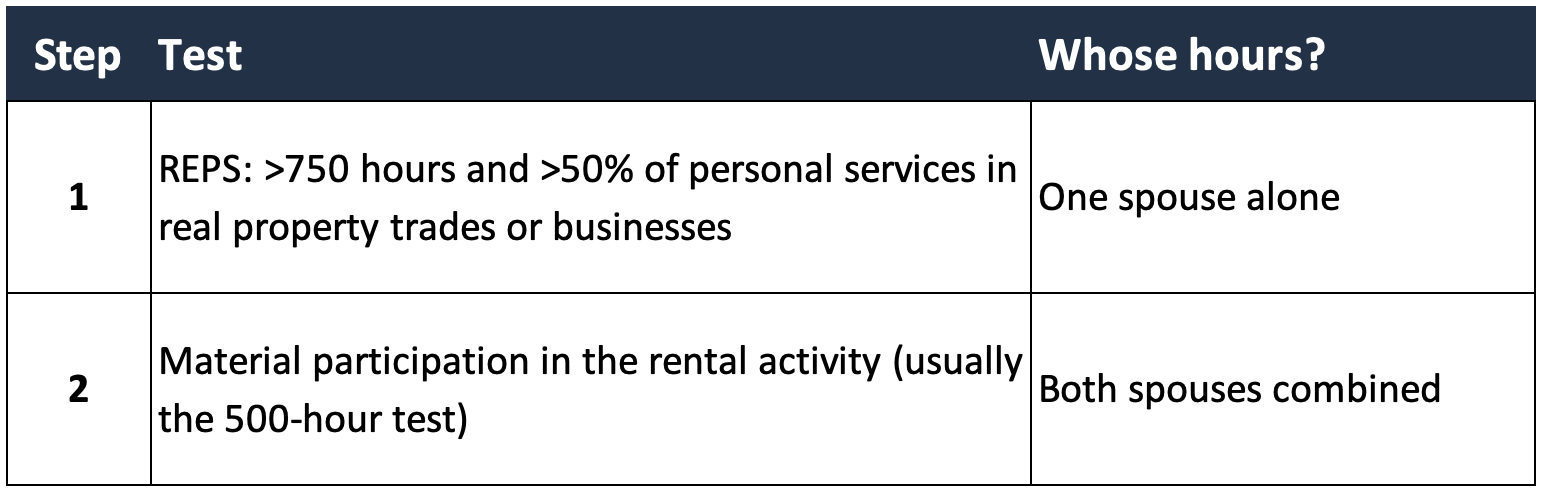
Worked example: Your spouse works 750 hours as a licensed agent showing homes, plus 250 hours managing your own rental portfolio — 1,000 hours total, all of it in real estate, comfortably more than half of their working time. Step one: cleared.
But agent hours showing other people’s houses do not count as participation in your properties. On their own, 250 hours falls short of the 500-hour material participation threshold.
Now add your 300 hours managing the same portfolio. Combined: 550 hours. Step two: cleared.
The result is that all of the portfolio’s depreciation becomes non-passive and available against your professional income — and it only works because the two tests use different rules about whose hours count.
What counts as a real property trade or business?
Section §469(c)(7)(C) gives an exhaustive list of eleven: development, redevelopment, construction, reconstruction, acquisition, conversion, rental, operation, management, leasing, and brokerage.
Notice what is not on it.
Real estate finance does not count. Mortgage brokerage, loan origination, and lending are not real property trades or businesses for this purpose. Neither is capital raising — which matters enormously for the syndicator audience. If your working week is spent talking to LPs and building models, those hours are not building toward REPS, however real-estate-adjacent they feel.
Two further conditions catch people:
Employee hours generally don’t count unless you own more than 5% of the employer. A property manager on someone else’s payroll with no equity cannot use those hours.
Personal services means your own labor. Capital committed, deals sourced by others, and work performed by contractors do not accrue to you.
Group your properties, or fail the 500-hour test
This is the technical step that most self-directed investors miss entirely.
By default, material participation is tested activity by activity. Own five rental properties and you must clear 500 hours on each one — essentially impossible for anyone with a diversified portfolio.
Treasury Regulation §1.469-9(g) lets a qualifying real estate professional elect to treat all interests in rental real estate as a single activity. Make the election, and you test 500 combined hours across the whole portfolio instead of property by property.
For our own five properties in Idaho, this is the difference between qualifying easily and not qualifying at all.
Three things to know about the election:
It is made by attaching a statement to your original return, and it is binding for all future years unless there is a material change in facts and circumstances.
It aggregates rentals for the material participation test — it does not change the REPS hour count itself.
If you missed it in a prior year, relief for a late election may be available under Rev. Proc. 2011-34. Worth asking about before assuming the year is lost.
Once the election is in place, LP interests in syndications can also be brought into the grouping in appropriate circumstances — which is how a portfolio of passive investments starts contributing to an active, deductible position.
What if neither spouse can get there?
REPS is not the only route, and it is not always the right one.
The short-term rental exception. If a property’s average period of customer use is seven days or less, it is not a “rental activity” under Treas. Reg. §1.469-1T(e)(3)(ii)(A) at all — so the per-se-passive rule never applies and REPS is not required. You need only material participation, most often through the test requiring more than 100 hours where no other individual works more. This is the single best option for a two-career household.
Build passive income instead. An investor with substantial passive income can absorb passive losses without any hours at all. This is a legitimate strategic position, not a consolation prize. Our general advice is to be deliberately one thing or the other rather than drifting: build a coherent passive portfolio, or commit to active status.
Time the transition. For clients moving from one posture to the other, the sequencing matters. A year in which accumulated passive losses have been cleared is usually the right year to shift into active status, so nothing gets trapped on the wrong side of the line.
The part people underestimate
Real estate professional status is one of the highest-value positions in the individual tax code, and the IRS knows it. Hours are the entire case, and hours are what get examined.
The regulation itself is more permissive than its reputation — Treas. Reg. §1.469-5T(f)(4) allows participation to be established by any reasonable means and does not strictly require daily time reports. But the Tax Court has repeatedly rejected after-the-fact reconstructions, and taxpayers who show up with a spreadsheet built the week before the exam tend to lose, sometimes with accuracy-related penalties on top.
If your hours are comfortably over the line, documentation is a formality. If they are close, it is the whole case. Build the log as you go.
Frequently asked questions
Can my spouse and I combine hours to reach 750 for real estate professional status?
No. Section §469(c)(7)(B) requires the 750-hour test and the more-than-half-of-personal-services test to be met by one spouse individually, even on a joint return. Hours cannot be pooled to reach the threshold.
Do both spouses’ hours count for material participation?
Yes. Once one spouse qualifies as a real estate professional, §469(h)(5) treats participation by either spouse as participation by the taxpayer, so both spouses’ hours count toward the 500-hour material participation test on your properties.
Can I qualify for REPS if I have a full-time job?
It is very difficult. More than half of all your personal services must be in real property trades or businesses, so a 2,000-hour job would require more than 2,000 hours in real estate. For most two-income households, one spouse qualifies or the short-term rental exception is used instead.
Does capital raising count toward real estate professional hours?
No. The eleven qualifying real property trades or businesses in §469(c)(7)(C) do not include real estate finance, lending, mortgage brokerage or capital raising. Syndicators are often surprised that their core activity does not build toward REPS.
Do I need to make a grouping election?
Almost certainly, if you own more than one rental property. Without the election under Treas. Reg. §1.469-9(g), material participation is tested separately on each property, requiring 500 hours per property rather than 500 hours across the portfolio.
Is being a licensed realtor enough to qualify?
No. A license is evidence of the type of work but proves nothing about hours. You still need to document more than 750 hours and more than half your personal service time, and then separately establish material participation in your own rental activities.
Is your return actually claiming what you think it is?
We regularly review returns where a client believes they are treated as a real estate professional and the return says otherwise — no grouping election attached, rentals still reported as passive, depreciation parked on Form 8582.
It takes about thirty seconds to check.
Stonehan offers a free 15-minute tax return review. Send your most recent return, and James will confirm whether your REPS position is actually reflected in the filing — and what it would take to fix it if not.
Book a free 15-minute review →
James Bohan, CPA · Founder, Stonehan Accountancy, P.C. · Coeur d’Alene, Idaho CPA since 2011 · MRED, University of Southern California · Fourth-generation real estate developer
This article is educational content and is not tax advice. Tax advice requires a review of your specific facts and circumstances by a qualified professional.