
Why isn't a loss on your K-1 a deduction on your tax return?
Every allocated loss has to clear four sequential limitations before it reduces your tax bill: basis, at-risk, passive activity, and excess business loss. They apply in that order, and a loss that fails any one of them is suspended rather than deducted. Most investors only know about the third gate, which is why the other three are where deductions quietly die.
A loss on your K-1 is not a deduction on your return
This is the single most common misunderstanding we correct, and it costs people real money.
Your K-1 arrives showing a $400,000 loss. That number is an allocation. It tells you what share of the partnership’s loss was assigned to you under the operating agreement. It does not tell you whether you are allowed to deduct it.
Between the allocation and the deduction sit four separate statutory tests, each with its own rules, its own form, and its own carry-forward mechanics. A loss that clears three of them and fails the fourth is worth exactly nothing this year.
Think of it as a series of gates. Each one asks a different question.
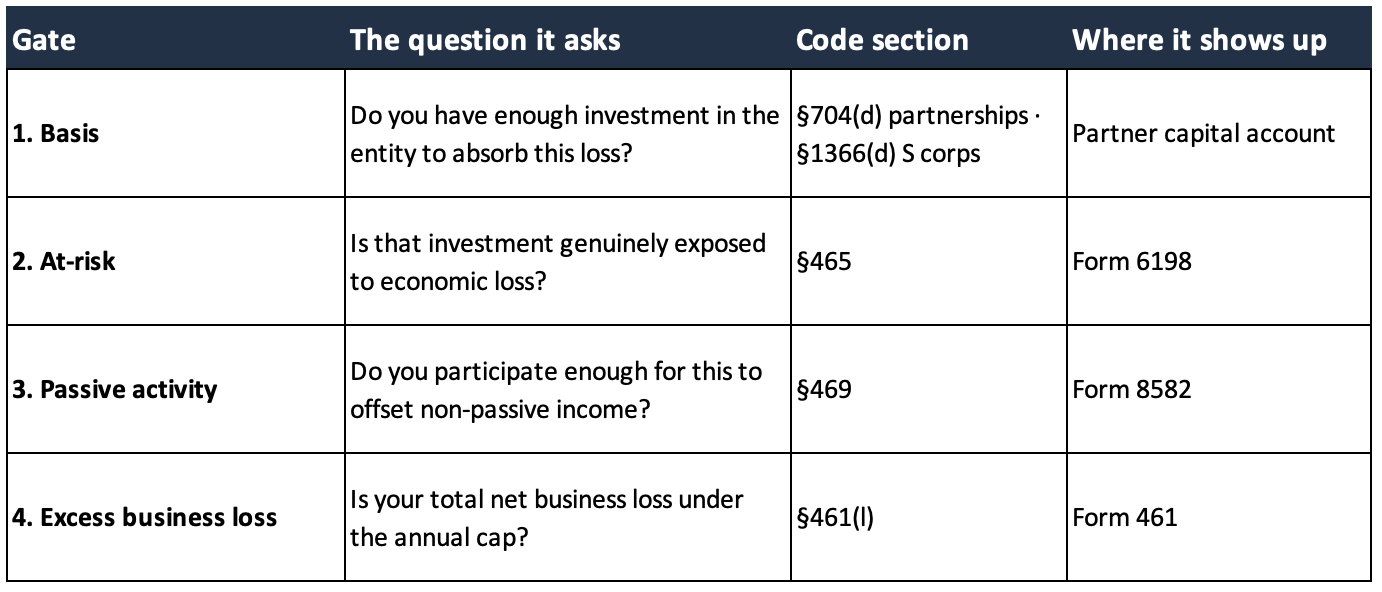
Gate 1 — Do you have basis?
You cannot deduct more than you have on the line. That is the whole principle.
Your basis in a partnership starts with what you contributed, goes up with income allocated to you and with your share of the entity’s liabilities, and goes down with distributions and losses already taken. Under §704(d), a loss in excess of basis is suspended until you have basis again — through more capital, more debt allocation, or future income.
The partnership advantage lives here. In a partnership or LLC, your share of entity-level debt under §752 increases your basis. That is why a leveraged real estate deal can hand you a deduction larger than your cash investment: the debt is part of your basis.
An S corporation does not work this way. Under §1366(d), shareholder basis is stock basis plus direct shareholder loans. Corporate-level debt creates none. This is precisely why a GP interest held inside an S corporation strands its depreciation — the debt that would have created your basis never reaches you.
Gate 2 — Is the basis at risk?
Having basis is not enough. Section §465 asks a second, narrower question: are you actually on the hook?
Amounts at risk include cash contributed, the adjusted basis of property contributed, and borrowed amounts for which you are personally liable or which are secured by property you own. Amounts protected against loss — through guarantees, stop-loss agreements, or non-recourse borrowing from a related party — are excluded.
Real estate gets a carve-out here, and it is a valuable one. Qualified non-recourse financing — debt secured by real property, borrowed from a commercial lender in the business of lending, where no one is personally liable — counts as at-risk under §465(b)(6) even though nobody has signed a personal guarantee.
This carve-out is why so much real estate depreciation is usable at all. It is also why the allocation of recourse versus non-recourse debt in your fund documents is not a formality. It determines who gets to use the deductions.
Worked example. A $10 million mobile home park. Investors put in $3 million; a $7 million loan is recourse to the sponsor. The first-year deduction from land improvements and bonus depreciation is $4 million.
The LPs have $3 million of basis and no share of the recourse debt, so $3 million of loss goes to them. The GP, who signed the recourse note, bears the economic risk of loss on that debt and can be allocated the remaining $1 million — despite having put in nothing. That is not aggressive; it is what §752 and §465 say when the documents are written correctly.
Gate 3 — Passive or non-passive?
This is the gate everybody has read about, and it is the most misunderstood word in the tax code.
“Passive” does not mean what it means in ordinary speech. Your dividend income is not passive under §469 — it is portfolio income. Passive means income or loss from a trade or business in which you do not materially participate, and, by default, from any rental activity.
There are three positions you can be in:
Passive. You are an LP in a syndication with no involvement. Passive losses offset passive income and nothing else. Excess suspends and carries forward under §469(b) until you have passive income or dispose of the activity.
This is a perfectly good outcome for many people, and it is under-appreciated. An investor with $2 million of passive income each year can absorb a great deal of juiced-up K-1 depreciation without ever thinking about hours. The guidance we give most often is to be deliberately one thing or the other — build a coherent passive portfolio, or go active — rather than drifting between them.
Active participation. A narrower allowance under §469(i) for individuals who own at least 10% and participate in management decisions on rental real estate. It permits up to $25,000 of loss against non-passive income, and it phases out between $100,000 and $150,000 of modified AGI. Most of our clients are well past it.
Material participation. Seven tests under Treas. Reg. §1.469-5T(a). The common ones: more than 500 hours in the activity; or more than 100 hours where no other individual works more. Meeting one of them makes the activity non-passive.
There is a catch specific to real estate. Under §469(c)(7), rental activity is per se passive regardless of how many hours you work — unless you qualify as a real estate professional. Real estate professional status does not by itself make your losses deductible. It removes the per-se-passive presumption, after which you still have to materially participate in the rental activity itself. Two gates inside one gate, and conflating them is the most frequent error we see.
Gate 4 — Excess business loss
You cleared basis. You cleared at-risk. You are a real estate professional who materially participates. The loss is finally non-passive and available to offset your W-2.
Up to a point.
Section §461(l) nets every trade or business you are in — Schedule C, K-1s, qualifying rentals, and Section 1231 gains — and caps the resulting net loss that can shelter non-business income. For 2026, per IRS Rev. Proc. 2025-32, that cap is $512,000 for joint filers and $256,000 for everyone else. Down from $626,000 and $313,000 in 2025, and now permanent.
Anything above the cap is disallowed for the year and carries forward as a net operating loss.
Where the deduction actually dies
The gates are sequential and cumulative. A loss must clear all four.
In practice, most planning conversations obsess over gate three and ignore the rest — which is exactly backwards, because gate three is the one you can most easily influence with hours and elections. The other three are structural. They are set by how the entity was formed, how the debt was allocated, and how you take money out of your businesses.
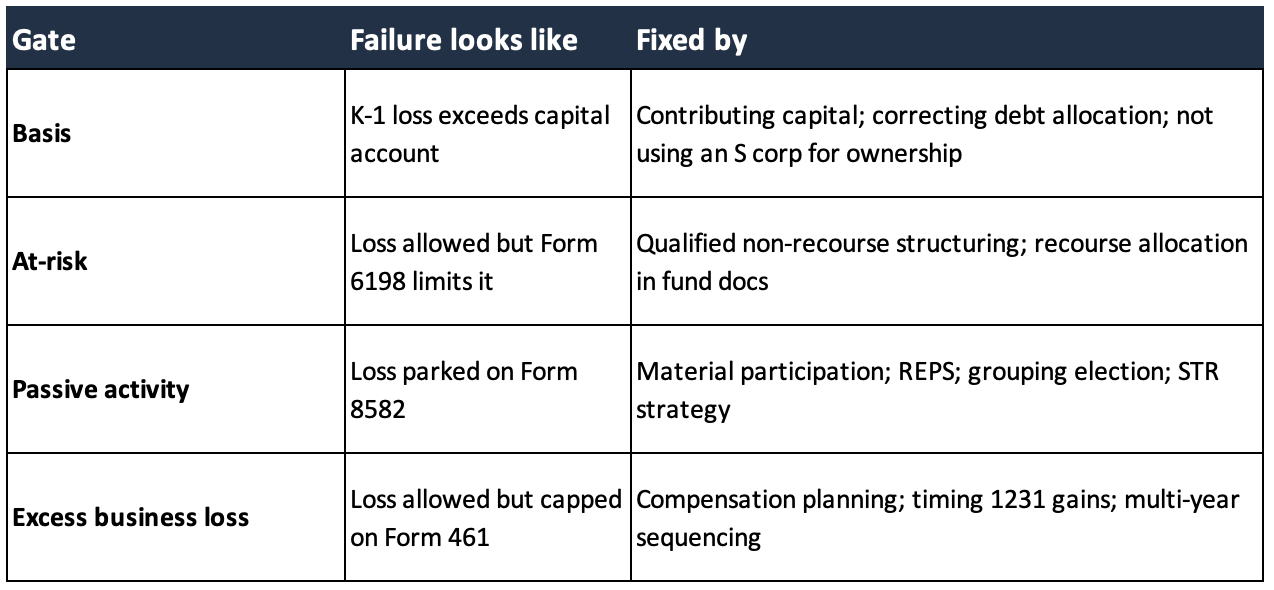
Each of the four suspends rather than destroys. Nothing is permanently lost. But a deduction deferred five years is worth substantially less than a deduction taken now, and the difference is entirely a function of whether anyone modeled it before the deal closed.
Run the gates before you buy, not in April
The practical version of all this is a single habit: before you commission a cost segregation study or sign a subscription agreement, walk the four gates against your actual situation.
Do I have basis, and does the entity structure preserve it? Is the debt allocated in a way that puts it at risk to me? Can I clear the participation threshold, or should I be building passive income to absorb this instead? And when it all nets out, does §461(l) cap it anyway?
Four questions. Ten minutes with someone who knows the answers. It is the cheapest diligence in this business, and it is almost never done.
Frequently asked questions
Why can’t I deduct the loss shown on my K-1?
A K-1 loss is an allocation, not a deduction. It must clear four sequential limits — basis under §704(d), at-risk under §465, passive activity under §469, and excess business loss under §461(l) — before it reduces your taxable income. Failing any one suspends the loss.
What is the difference between basis and at-risk basis?
Basis measures your investment in the entity, including your share of its liabilities. At-risk basis is narrower: it counts only amounts you could actually lose. Non-recourse debt generally creates basis but not at-risk amount, except for qualified non-recourse financing secured by real property.
Does real estate professional status make my losses deductible?
Not by itself. REPS removes the rule that treats rental activity as automatically passive. You must still materially participate in the rental activity, and the loss must still clear basis, at-risk and the excess business loss cap.
Do suspended losses expire?
No. Suspended losses carry forward indefinitely. Passive losses free up when you have passive income or fully dispose of the activity; basis and at-risk losses free up when you restore basis; excess business losses convert to net operating loss carryforwards.
Which gate stops most investors?
Basis and at-risk stop more deductions than most people realize, usually because of an entity choice made years earlier — most commonly holding an ownership interest inside an S corporation, which blocks debt from creating shareholder basis.
Can I fix a gate problem after the year ends?
Rarely. Basis, at-risk allocation and compensation decisions all have to be in place before December 31. By the time a return is being prepared, the year is closed and the only remaining question is how to report what already happened.
Find out which gate is stopping your deductions
If you have suspended losses on your return and you are not sure why, the answer is on the return — usually on Form 6198, Form 8582 or Form 461, and usually traceable to a structural decision made before the deal closed.
Stonehan offers a free 15-minute tax return review. James will look at your last personal and business return and tell you what he sees: which gate is binding, whether it is fixable, and what it is costing you.
Book a free 15-minute review →
James Bohan, CPA · Founder, Stonehan Accountancy, P.C. · Coeur d’Alene, Idaho CPA since 2011 · MRED, University of Southern California · Fourth-generation real estate developer · Former CFO, private equity debt fund
This article is educational content and is not tax advice. Tax advice requires a review of your specific facts and circumstances by a qualified professional.